The System of Rice Intensification (SRI) Contributions to Agricultural Sustainability-II
The system of rice intensification, developed some four decades ago in Madagascar, started receiving international attention only after 2002. As SRI methods have repeatedly been found to evoke more productive and robust rice phenotypes from given genotypes, its use has spread, and the methodology has now been validated in >60 countries. During this process, the […]

LE COUPLAGE DE L’APPROCHE SMART-VALLEYS ET SRI
Le Smart-valleys est une approche de dévelop- pement de bas-fonds pour des systèmes de pro- duction rizicole en Afrique sub-saharienne, ba- sée sur une démarche participative, durable et à faible coût. Elle a été développée par le Centre du riz pour l’Afrique (AfricaRice) et ses partenaires de recherche, en 1997 et 2001 au Ghana et […]

Tanzania Agricultural Research Institute
Rice farmers have expressed their satisfaction with the project of System of Rice Intensification (SRI) in Tanzania that withstands the effects of climate change, which reduces production costs while productivity doubles that of conventional agriculture. This was stated during the SRI Stakeholders Annual workshop held in Mbeya Region on January 24 through 27 at the […]
Enhancing food security in developing countries
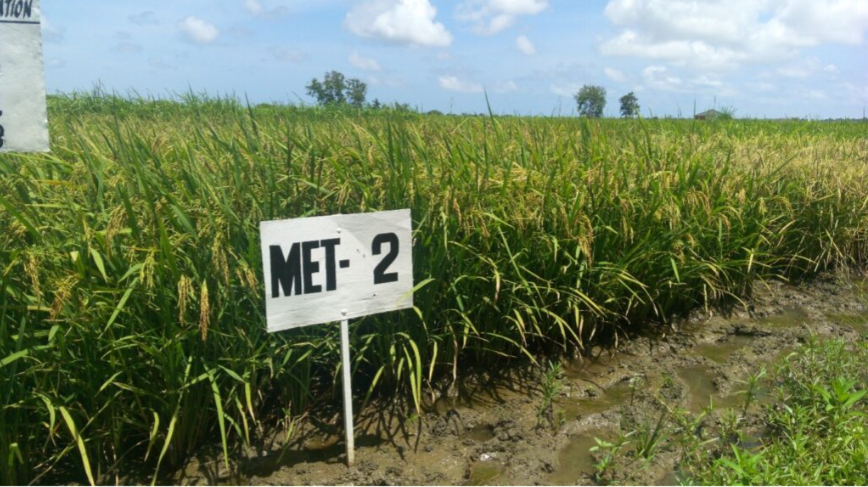
Enhancing food security in developing countries The Matial Environmental Trial (MET -2) rice variety is resistant to drought and high levels of salt in the soil, offering farmers a new breed that can produce optimally in the face of worsening effects of climate change on agriculture. The variety’s needle-like leaves also protect the rice from […]
Competition des pratiques rizicoles et avantages de la technique du SRI pendant la saison culturale VARY BE
A Madagascar, 78,7 % de la population sont agricoles dont 83,7 % pratiquent l’agriculture à titre d’activité principale (INSTAT, Campagne 2004-2005), de plus la part de l’agriculture dans le PIB total est de 28 % (FAO, 2008). Le développement de l’agriculture est alors un des facteurs clés pour dynamiser le pays. Concernant la riziculture, elle […]

A Best-Bet System of Rice Intensification and Poverty Alleviation in Zamfara State, Nigeria: A Mixed Method Analysis
CONTEXT Zamfara State is impoverished due to low agricultural productivity, inadequate infrastructure, and insecurity. Research has explored System of Rice Intensification (SRI)’s agronomic benefits but not its monetary and non-monetary advantages for rural households in the State. OBJECTIVE The study investigates the effectiveness of a best-bet SRI (BB-SRI) as a poverty alleviation strategy in Zamfara […]

In Senegal, rice intensification helps farmers grow more with less
In Senegal, rice intensification helps farmers grow more with less by Noah Tobias on 30 May 2023 To fight food insecurity and climate change, Senegal is increasingly employing a relatively new strategy for growing rice, known as the “system of rice intensification” (SRI). Developed in Madagascar in the 1960s, this method of growing rice intentionally stresses the […]

A cost benefits analysis of the adoption of system of rice intensification: Evidence from smallholder rice farmers within an innovation platform in Oluch irrigation scheme, Kenya
In the wake of climate change and dwindling natural resources, system of rice intensification has been fronted as an approach to improve rice production in several countries. Besides the benefits such as improved rice productivity, reduced water usage that have widely been observed, there is need to quantify the economic benefits of system of rice […]

Scaling-up climate-resilient rice production in West Africa
West Africa has had an impressive economic growth in the past two decades, with economic growth rates at above 5% between 2000 and 2014 (Africa’s Development Dynamics 2018)1. Yet it is uneven as Nigeria, Ghana and Côte d’Ivoire represent 85% of regional Gross domestic product (GDP). High informality, increasing inequalities and poverty also undermine growth […]

Kenya: A cost benefits analysis of the adoption of system of rice intensification: Evidence from smallholder rice farmers within an innovation platform in Oluch irrigation scheme, Kenya
In the wake of climate change and dwindling natural resources, system of rice intensification has been fronted as an approach to improve rice production in several countries. Besides the benefits such as improved rice productivity, reduced water usage that have widely been observed, there is need to quantify the economic benefits of system of rice […]

Mali: A participatory framework for prioritizing climate-smart agriculture innovations in rice-based systems: A case study of Mali
Alleviating the climate-related constraints faced by agri-food systems in sub-Saharan Africa requires an accelerated adoption of climate-smart agriculture (CSA) innovations by farmers. However, little is known about the best-bet (most appropriate) CSA innovations, and the enabling conditions for their widespread adoption in a given biophysical and socioeconomic context. The objectives of this study were to […]

Social Capital proves critical to success of System of Rice Intensification (SRI) farming in Tanzania
Social Capital proves critical to success of System of Rice Intensification (SRI) farming in Tanzania Social capital is defined as the enduring connections of networks, reciprocity and social norms that exist among a group of people. In farming, social capital has various benefits such as facilitating farmer-to-farmer knowledge sharing, increasing access to information, and connecting […]