Promoting the System of Rice Intensification (SRI) in Ndoundour: An Agroecological Dynamic Led by Women
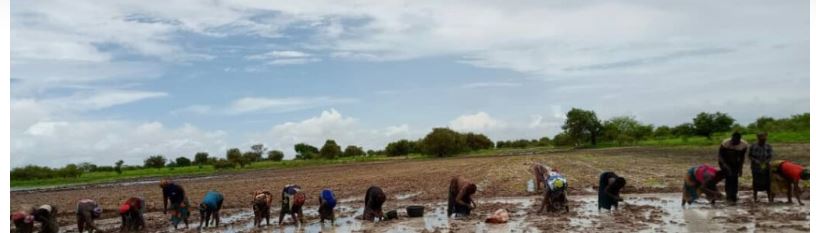
As part of the collaboration between the SRI-2030 initiative and Enda Pronat , a farmer field school (FFS) has been established in Ndoundour to experiment with and promote the System of Rice Intensification (SRI) . Led by women from the local Women’s Promotion Group (WPG) , this initiative marks a key step towards more ecological, economical, and productive rice farming.
In Ndoundour, the Farmer Field School (FFS) is led by the women producers of the Ndoundour Women’s Promotion Group. The farmer field school is located in the group’s collective rice paddy. Discussions with the women producers involved in the group have led to the development of the co-defined treatments (plots) or options, which are:
- Peasant practice (traditional local practices, producers sow the rice broadcast)
- The SRI nursery: setting up a 15-day nursery, transplanting with one stem/pot and a spacing of 30 cm between plants and between rows, application of organic matter and weeding.
- SRI direct sowing: sowing two grains of rice per pocket 30 cm apart, thinning 15 days later to leave one plant per pocket, application of organic matter and hoeing.
Traditional farming practices involve broadcast sowing (80 kg/ha according to the reference method). For both SRI (System of Reconstructed Irrigation) practices, a row of seedlings spaced 30 cm apart was used for transplanting and direct sowing. Nursery-based SRI allows for seed savings (8 kg/ha) compared to traditional farming practices.

Transplanting of the SRI nursery plot using a rope by the producers
CEP animation or co-evaluation days
The collaborative approach aims to be participatory in all its activities. It is a means of appropriating and adopting the innovation of the intensive rice farming system. Therefore, it is planned to hold CEP (Center for Experimental Practices) sessions every two weeks. To date, two sessions have been conducted at the Ndoundour CEP. During the sessions, participants are divided into three groups. The groups take turns evaluating, based on agronomic observation, the different rice farming practices (farmer’s practice, SRI Nursery, and SRI Direct Seeding). Participants in each group quantify or measure rice growth parameters such as the number of tillers per plant and the height of the rice. At this stage, the farmers have noted that the two SRI practices result in better height development, more tillers, and better coloration compared to the farmer’s practice. The latter exhibits stunted plants and a yellowing coloration for the majority of plants, caused by the high density, according to the participants.

Measurement of rice height in the SRI plot by the women producers of the Ndoundour group
Strong mobilization of female producers
The women farmers of the Ndoundour group are heavily involved in the various activities carried out at the farmer field school. They are particularly interested in experimenting with the System of Rice Intensification (SRI). Most of the farmers are new to this agroecological technique and are committed to adopting SRI. According to the farmers, the biggest challenge to scaling up this agroecological technique remains mobilization.

The producers of GPF Ndoundour sing and dance with joy at the close of the day’s activities.
Capacity building
The collaborative activities have enabled capacity building in the following areas:
- The theoretical aspects of SRI practice
- The establishment and monitoring of a rice nursery
- The principles and operation of a farmer field school
- The ability to qualitatively and quantitatively assess a rice farm or plot
- Training for young people from the village to operate a motorized cultivator (also planned)
Support in the form of small mechanization equipment
To reduce the arduousness of the work and encourage widespread adoption of the System of Rice Intensification (SRI), the collaboration supported experimental farmers using rotary hoes. These small, mechanically operated tools allow for weeding and hoeing of rice paddies, making them well-suited to SRI.
Article source: https://endapronat.org/promotion-du-systeme-de-riziculture-intensive-sri-a-ndoundour-une-dynamique-agroecologique-portee-par-les-femmes/