Comprehensive review of the system of rice intensification to enhance productivity and environmental sustainability in major rice-producing countries

Context
The System of Rice Intensification (SRI) is a sustainable rice cultivation method designed to enhance productivity while minimizing resource inputs. It addresses global food security and environmental challenges by improving yield, reducing water use, and mitigating greenhouse gas emissions, particularly in resource-constrained agricultural systems.
Objective
This review aims to evaluate the core principles of SRI, their impacts on rice yield, resource efficiency, and environmental sustainability, and to identify barriers to adoption and potential solutions for scaling up its implementation.
Methods
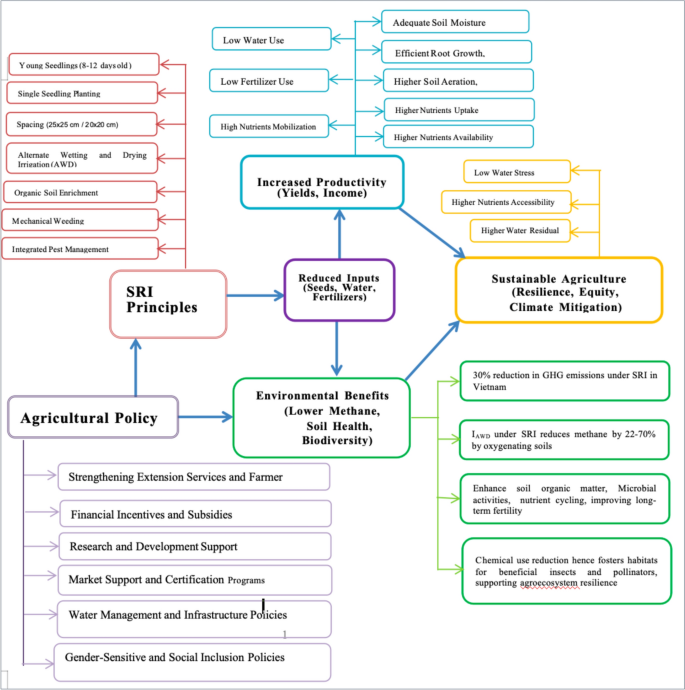
The review synthesizes findings from studies across diverse regions, including Bangladesh, India, Myanmar, Benin, Kenya, and Tanzania. It examines SRI’s core practices—transplanting young seedlings (8–12 days old), wider plant spacing (20 × 20 cm or 25 × 25 cm), alternate wetting and drying (AWD) irrigation, and organic nutrient management—and their effects on yield, water use, soil health, and greenhouse gas emissions. Challenges to adoption and labor-saving technologies are also analyzed.
Results
SRI has achieved yield increases of 10–114% compared to conventional methods, with water savings of 40–74% due to AWD irrigation. Methane emissions are reduced by up to 70%, while enhanced soil microbial activity and improved root development increase plant vigor and resilience to drought and pests. However, adoption is hindered by labor-intensive practices, knowledge gaps, and limited access to training and irrigation infrastructure. Mechanization, such as drum seeders and mechanical weeders, can reduce labor by up to 97% and 28.3%, respectively, but access remains limited.
Conclusions
SRI offers significant potential for sustainable rice production by improving yield, resource efficiency, and environmental outcomes. However, its scalability is constrained by labor demands and knowledge barriers. Mechanization and enhanced extension services are critical to overcoming these challenges.
Significance
SRI provides a pathway to address food security and environmental sustainability, particularly for resource-poor farmers. Future research should focus on optimizing SRI for diverse agro-ecological conditions, developing affordable labor-saving technologies, and strengthening policy support to enhance adoption and long-term impacts on soil health, carbon sequestration, and nutritional outcomes.
Article Source: https://link.springer.com/article/10.1007/s44187-025-00648-4