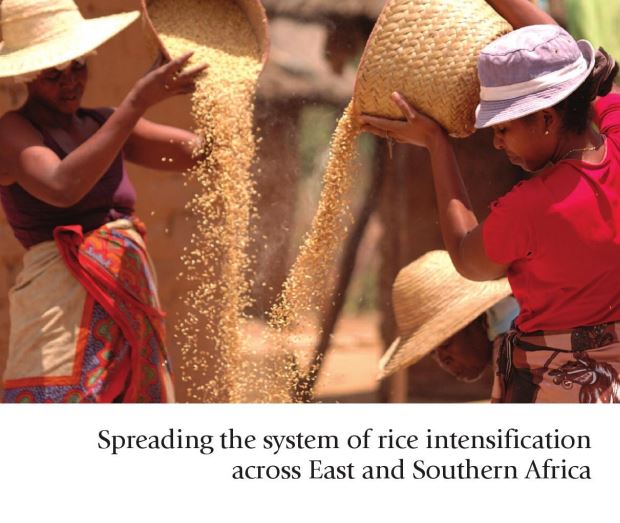
Spreading the system of rice intensification across East and Southern Africa
SRI is an innovative concept. This new system cannot be considered a “technique”. SRI is more
of a philosophy based on good management of the rice plant, the soil and the water conditions.
N. Uphoff describes SRI as “an innovation that encourages further innovation”. It is also an ongoing innovation. The system is not a standardized methododology, but gives guidance to
farmers who are willing to search for new and more productive ways to cultivate rice. Therefore
farmers living in different regions with different soil, water and weather conditions can identify
different cultivation methods by adapting the general SRI practices to their needs.
SRI emphasizes the revival of the natural growth potential of rice, which has been affected by
traditional cultivation techniques, particularly where these rely on using and “recycling”
traditional seeds, which leads to their gradual loss of productivity. This new system is not the
direct product of laboratory research, even though scientists and agronomists have studied SRI
practices and their results. It originated in civil society in the 1980s from the fieldwork and
studies of Henri de Laulanié, a French Jesuit priest and agronomist who lived in Madagascar and
worked closely with Malagasy farmers and friends to increase food security in the country by
improving the production potential of rice, the staple food in the country.
Hence, SRI is a set of “good practices” to increase rice yields, derived from careful observations,
with adjustments made according to needs and conditions. In line with the core idea of SRI, the
same practices initially developed by de Laulanié evolved according to the actual environment
in Madagascar. For example, in the beginning, SRI relied on chemical fertilizers to complement
the set of practices to manage the plant, the soil and the water. The context changed as the
government of Madagascar removed subsidies on fertilizers, making them unaffordable for
smallholder farmers. Organic compost was then introduced as a cheaper alternative to enhance
the soil’s nutritional composition, and the results were very positive. In fact, the use of organic
fertilizers combined with other SRI practices enhanced yields even more than when chemical
fertilizers were used.
Article source: https://www.ifad.org/documents/38714170/39135645/SRI%20case%20study.pdf/fb791e52-e01f-4812-93d7-19b43edc6c2c