SRI and the Malagasy paradox of short-termism, or “When Madagascar imports rice of its own invention”
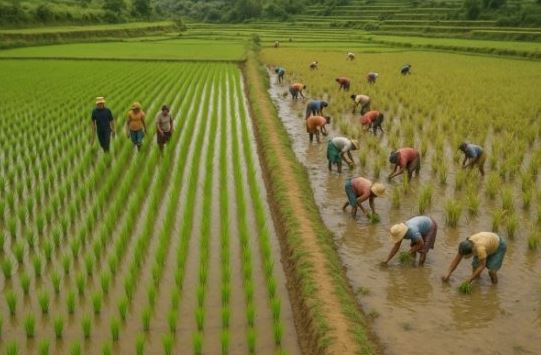
Abstract : The relative failure of the System of Rice Intensification (SRI) in Madagascar reveals a deep-seated societal paradigm: a systematic preference for short-term security at the expense of promising long-term investments. Invented by Malagasy farmers in the 1980s, SRI has shown remarkable performance in over 50 countries (yield gains of 30-100%, water savings of 40%), but Madagascar has achieved only 20-25% effective adoption and now imports rice from countries using this Malagasy technique. This dynamic illustrates a fundamental mechanism that structures all areas of Malagasy collective life: politics, the economy, education, health, and the environment. This preference for the immediate, while revealing an anthropologically universal tendency of humanity, is reinforced in Madagascar by chronic uncertainty and poverty, creating a vicious cycle that jeopardizes the country’s future.
The history of the System of Rice Intensification (SRI) in Madagascar extends far beyond agriculture, perhaps revealing a profound societal paradigm that permeates all aspects of our collective life. This innovation, which originated in the rice paddies of Antananarivo and Fianarantsoa in the 1980s, serves as a textbook case illustrating how the systematic preference for short-term security at the expense of promising medium- to long-term investments shapes our collective and individual choices.
The SRI had all the characteristics of what could have been a technical and agricultural revolution: local participatory design by Malagasy farmers, low input costs, adaptation to national constraints, reduction of water constraints, considerable yield potential… Here, its relative failure in Madagascar reveals mechanisms that go beyond agriculture to question our collective relationship to risk, innovation and development.
The SRI: a revealer of a national paradigm?
The SRI figures speak for themselves and perfectly illustrate this Malagasy enigma and paradox. Globally, the system demonstrates remarkable performance in over fifty countries that have adopted it: yield increases of 30% to 100%, water savings of 40%, and reduced input costs. In sub-Saharan Africa, documented yield increases range from 37% to 100%.
The situation is all the more absurd given that Madagascar, where the rate of effective SRI practices does not exceed 20 to 25% of trained households, now imports rice from countries that have adopted a technique invented by and for Malagasy farmers… a technique that allows these countries to generate surpluses for export… to Madagascar… It doesn’t get more absurd than that…
Even more revealing: in Madagascar, 70% of initial adopters will abandon the technique. This situation reveals a fundamental mechanism: faced with a promising but demanding innovation (which requires 38% to 54% more work but for gains that can be up to six times greater than traditional farming practices), producers overwhelmingly prioritize the immediate security of the traditional system, even if less efficient, rather than investing in a technique whose proven and attested benefits will only materialize in the medium term. However, they cannot be blamed for this. [1]
The political paradigm: electoralism versus strategic vision
A clear manifestation of this dynamic, where short-term goals are prioritized over long-term planning, even when the latter proves promising, can be seen in the analysis of Malagasy public policies, or at least the political practices of certain individuals. It reveals a systematic preference for measures with an immediate positive public image, at the expense of the structural reforms necessary for long-term development.
But it must be acknowledged that, on the subject of rice, since independence successive governments seem to have consistently resorted to massive rice imports and free distributions during pre-election periods… Easier to implement than promoting MASSIVE investments in agricultural infrastructure, agronomic research, or farmer training. This strategy of opportunistic imports could guarantee immediate social peace and, above all, electoral gains, but it perpetuates the country’s food dependency.
Infrastructure management policy also illustrates this paradigm. High-profile projects, with grand opening ceremonies for 8 kilometers of highway, are always launched at the expense of less spectacular but more structural investments, such as improving rural roads. This approach explains why Madagascar accumulates foundation stones and inaugurations without ever developing truly coherent sectoral policies.
The survival economy: when the informal sector takes precedence over productive investment
The Malagasy economic sector perfectly illustrates this preference for immediate security. Doesn’t the hypertrophy of the informal sector – which represents more than 70% of the economy – testify to these preferences for daily survival?
Faced with an unstable institutional environment and difficulties accessing credit, Malagasy entrepreneurs overwhelmingly favor fast-moving commercial activities over long-term investments, whether artisanal, commercial, industrial, or agricultural. This approach aims to secure immediate (and low) incomes, but significantly limits the prospects for creating greater added value and sustainable employment.
The mining sector is another telling example. Despite its known considerable resources, policies seem to favor artisanal mining and the export of raw materials over the development of processing industries. This approach, which affects both large-scale mining operations and small-scale stone and gold mining, generates immediate revenue but deprives the country of the benefits of a value chain built through processing. It is highly likely, however, that this system is maintained for the benefit of a select few.
Education sacrificed: when economic urgency takes precedence over training
The education sector is perhaps the most dramatic illustration of this short-term political paradigm. At the institutional level, faced with budget deficits, the Malagasy state will prioritize reducing investments in the national education budget… while maintaining operating expenses… Here again, the aim is to artificially preserve immediate social peace, but this seriously jeopardizes the quality of the education system… and the future of the country’s vital forces.
Even today, many Malagasy families prioritize their children’s immediate integration into income-generating activities rather than pursuing education whose benefits will only materialize in the long term. This logic explains the high dropout rates, particularly in rural areas where children are quickly mobilized for agricultural work or family businesses. Families make a rational calculation: a working child generates immediate income, while a child in school represents a cost with no guaranteed return on investment.
Health and the environment: urgency versus sustainability
The Malagasy healthcare system also reveals this same preference for immediate solutions. Health policies systematically prioritize emergency curative interventions at the expense of prevention programs. The program to combat sickle cell disease, which focused on information, screening, education—in short, on anticipation—has had its priorities revised, risking a surge in the spread of a disease known for its extreme virulence. Here again, the preference is to invest massively in emergency vaccination campaigns during epidemics while neglecting the strengthening of the basic healthcare system.
Environmental management similarly illustrates the disastrous consequences of this aversion to the future. Faced with immediate economic pressures, local communities prioritize the exploitation of natural resources over their conservation. Massive deforestation testifies to this logic: farmers favor converting forests into agricultural land or producing charcoal, activities that generate immediate income, rather than forest conservation, the benefits of which only materialize in the long term.
Cognitive biases: an anthropological constant
This widespread preference for the short term is not irrational but is rooted in deep psycho-sociological mechanisms.
And make no mistake: this is not about imagining some purely Malagasy bias that would be stated as: “it is a cultural problem of the Malagasy who do not know how to imagine a greater tomorrow.”
No… These temporal myopia biases are universal. This universality reveals their profoundly anthropological nature. The cognitive mechanisms that lead us to prioritize immediate gains over future benefits, to overestimate the risks of innovation and underestimate the costs of the status quo, are constants of human psychology… What we call cognitive biases of comfort or negativity… The short-termism of financial capitalism is an illustration of this… As is the inability of modern world leaders to establish a political line on climate change, which we know is leading us to disaster…
The difference between developed and developing countries lies not in the absence or presence of these biases, but in the institutional capacity (limited, but it exists) to counteract them. Developed countries have progressively built institutions (social protection systems, long-term financing mechanisms, democratic checks and balances) that help limit the perverse effects of short-termism… even if we must regret that they are not… less appalling.
However, these characteristics are amplified in Madagascar by the socio-economic context. Chronic uncertainty is the primary explanatory factor. In an environment characterized by political instability, poverty, recurring economic crises, and a lack of social protection, actors naturally develop risk-minimization strategies that prioritize certain short-term gains.
Widespread poverty reinforces this logic. When daily survival is at stake, it becomes rational to prioritize immediate income, however meager, over long-term investments, however promising. The absence of social safety nets amplifies this phenomenon: without a safety net, individuals cannot afford to take risks that could jeopardize their immediate survival.
The paradigm exhibits the perverse characteristic of a vicious circle. The more actors prioritize short-term solutions, the more they weaken the foundations of long-term development, thereby increasing uncertainty and retroactively justifying policies of immediate action. This dynamic partially explains why Madagascar seems trapped in a state of underdevelopment from which it struggles to escape despite its potential.
Towards a revolution in mindsets: exit strategies
Moving beyond this paradigm requires a systemic approach that simultaneously addresses the causes and consequences of short-termism. This approach must integrate several complementary dimensions: reducing uncertainty by strengthening institutional stability and developing social protection mechanisms; supporting transitions to enable stakeholders to gradually shift from short-term thinking to long-term strategies; and demonstrating success through pilot projects that can generate a ripple effect.
Analyzing the paradigm of this Malagasy preference for short-termism reveals the need for a genuine cultural revolution, a revolution of mindsets. This revolution cannot be imposed from the outside but must emerge from a collective awareness of the costs of short-termism and the potential benefits of long-term strategies. It implies a profound shift in our relationship to time, risk, and innovation. It requires the development of a shared vision of development that transcends political and social divisions. It also demands moving beyond the short-sighted, “tia kely” mentality with which we are too often content… in order to rediscover ambition.
Conclusion: From SRI to civilizational challenges… but respect is also a matter of…
The history of SRI in Madagascar ultimately reveals issues that extend far beyond agriculture, challenging our societal model. It illustrates how the systematic preference for short-term security at the expense of promising long-term investments shapes our collective choices and jeopardizes our future.
This analysis suggests that Madagascar’s development cannot occur without a profound transformation of our relationship to time and risk. It calls for replacing the logic of immediate survival with strategies for investing in the future, and the impulses of managing the immediate present with a long-term vision. The challenge is considerable, as it involves changing behaviors deeply rooted in our history and culture. But the stakes are high: it concerns our collective capacity to build a sustainable future for generations to come.
These conditions go far beyond the technical realm, challenging our societal models and civilizational choices. Perhaps this is the true lesson of this story: that development is first and foremost a matter of transforming mindsets and social structures.
The SRI experience has finally taught us that good ideas alone are not enough. The “just do it” approach must be banished… just as top-down approaches that propose brilliant initiatives without any guarantee of the need they are supposed to address… and therefore, of their adoption. Experience teaches us that we cannot impose policies and solutions on people based solely on our supposed sincerity and competence… Absolute humility is required…
And it teaches us that the transformation of mentalities mentioned cannot be attributed solely to the realm of economic rationality… but to the realm of the heart… It is indeed a true cultural revolution.
Article source: https://www-madagascar–tribune-com.translate.goog/SRI-et-le-paradoxe-malgache-du.html?_x_tr_sl=fr&_x_tr_tl=en&_x_tr_hl=en&_x_tr_pto=sc