Spreading the system of rice intensification across East and Southern Africa
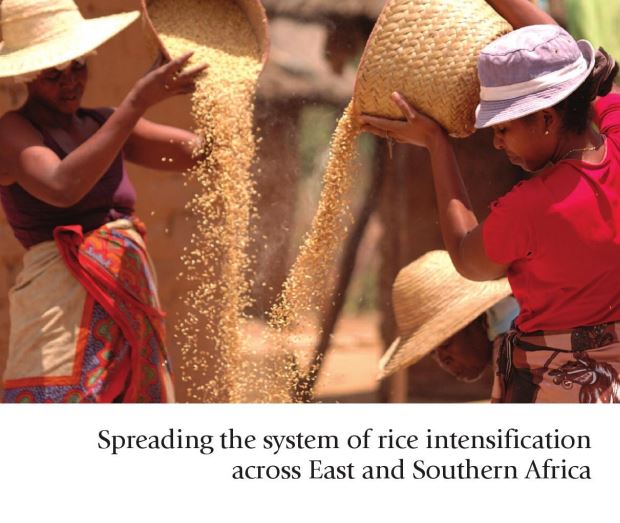
Rice is the staple food for many countries across the developing world, particularly in Asia, Latin
America and Africa. It fulfils the food energy needs of around half of the world’s population.
1 In
sub-Saharan Africa, where 93 per cent of farm land is rain-fed, rice is a good crop alternative
due to its ability to be cultivated during the wet season. Nevertheless, rice yields are severely
affected by the weather fluctuations of the rain-fed ecosystems. Drought, flooding and unstable
and extreme temperatures threaten the productivity of rice fields and the quality of grains.
In many East and Southern African countries, rice is a staple food for rural households.
Increasing rice production is one of the most powerful pathways to improve household food
security and reduce rural poverty.
In the 1980s, a Jesuit priest living in Madagascar discovered a new way of farming rice that
significantly increased production. This new System of Rice Intensification (SRI) aimed to revive
the natural growth potential of rice through a set of good practices that question traditional
farming methods. In particular, with this new system, fields are not kept flooded. The soil is kept
alternately dry or wet, allowing the plants’ roots to take oxygen from the ground surface. In this
way less water and fewer seeds are needed to produce the same quantity of rice. Seedlings are
transplanted while very young from the nursery to the field, one by one, in square patterns to
allow spacing between rice plants. In addition, the use of organic fertilizers combined with SRI
practices is recommended as in many cases it gives even better results than chemical fertilizers.
The reduced need for inputs (such as water, seed and chemical fertilizer) makes SRI affordable
to poor smallholders, and its successes enhance its potential for replication.
In 1997, after the food crisis in Madagascar, IFAD introduced SRI in its projects in the country,
starting with the Projet de Mise en Valeur du Haut Bassin du Mandraré (Upper Mandraré Basin
Development Project – PHBM). The project successfully rehabilitated the Mandraré inlandvalley lowlands by improving rural infrastructure and promoting the adoption of SRI practices.
From Madagascar, SRI was brought to Rwanda and then to Burundi. IFAD and the Malagasy
non-governmental organization (NGO) Tefy Saina, founded by SRI’s pioneer, promoted the new
set of practices among farmers and facilitated its dissemination through training visits across
borders.
Despite its very good results, SRI is still seen as a risky practice by some farmers, and its success
has not spread as quickly as expected, particularly in Madagascar. The mind-set there still clings
to traditional practices for different reasons. One of them is the perception of a bigger workload
for farmers who take up SRI practices. This is actually true, at least in the initial stages of
adoption. However, once farmers gain familiarity with the new techniques, form farmer groups
or associations, and start using mechanical tools, the individual workload for SRI decreases
significantly. Often households do not have enough labour available from family members and
cannot afford to pay external workers. Therefore, they remain wary of any practices that may
require additional labour resources. Other barriers can be scarce access to fertilizers (organic,
mineral or chemical) and inadequate irrigation infrastructure, which does not allow for careful
water management in SRI’s fields..
Article source: https://www.ifad.org/documents/38714170/39135645/SRI%20case%20study.pdf/fb791e52-e01f-4812-93d7-19b43edc6c2c